
Issue- 2
Title- The Final Victory of Doctor Doom
Writer- Stan Lee
Art- Jack Kirby
Summary:
After floating in space for some time after his recent defeat at the hands of the Fantastic Four, Doom is rescued by Rama-Tut. In his space craft, Rama-Tut reveals to Doom that he is from the 25th Century and that he traveled back in time using the device created by his ancestor, Dr. Doom. The two then theorize that they could somehow be the same person in two different points in the existence. After discarding the idea of teaming up against the FF as to dangerous to both their existence's, the two part company. Doom then plans his next attack on the team at the Latverian Embassy, where UN officials are puzzled by the secret of who truly rules the small nation of Latveria. As the first part of Doom's plan, he has the Latverian Ambassador invite the team to a party. At the party, the team, except for Reed, are drugged and begin to have illusions that pit each one against the other. Unaffected, Reed manages to reveal what has happened to them and the team returns to their headquarters. Doom is already ahead of them and they engage in battle. By harnessing Human Torch's nova flame, Reed manages to disable Doom's force field which allows Thing to fight him hand to hand. Eventually Reed challenges Doom to a duel of the mind using the Encephalo-Gun. The gun tests the intellect of the two fighters and send the loser into a limbo dimension. Almost instantly after the battle begins, Reed disappears into nothingness, and Doom declares victory. Having beaten Reed, Doom leaves the others triumphantly. Meanwhile, the team looks on puzzled because Doom says he has beaten Reed, but Reed is still there. After Doom has left, Reed explains that he drugged Doom with the same potion he used on them and gave him the illusion of victory.
Notes:
-
The time traveling criminal Rama-Tut claims that his time machine was created by his ancestor, Doctor Doom.
-
Until the events of this issue, Latveria was publicly in the world's eyes ruled by a Prime Minister
-
Doom's first use of his armor's force-field
-
Reprinted in Fantastic Four Annual #7, Marvel Masterworks: Fantastic Four Volume 4 (pictured below)


Comments:
Although not one of my favorite stories, this annual is definitely one of the most pivotal in Doom's history. First and foremost we have the first meeting of Rama-Tut [a.k.a Kang the Conqueror] and Doom. The temporal techno-babble which the two engage in is quite simply nonsense. It makes no sense that Rama-Tut could be Doom in the future without he remembering his own past, or vice-versa. Unless we're talking about either one having their memory wiped, which is also a long shot. This intriguing and challenging idea put forth by Stan Lee here unfortunately is not executed very well. It seems to have only served to boggle the minds of readers and feed years worth of endless theories about the mysterious connection between the two. Which I suppose if that was Lee's intention, then it worked. Despite whatever retcons have come in later years, I prefer to think that the two have no connection whatsoever.
The second significant revelation here is that of Latveria itself. Up until now, Doom has been a traveling villain not based in any specific place. Beginning here however, that changes. We learn here that Latveria, a small European country, is supposedly ruled by a Prime Minister, but many suspect that there is someone else. That of course turns out to be Doom himself. This was a great idea which I really enjoyed. Its a shame once the cat is out of the bag, there nothing more to be done with it. Doom's "final" victory is okay. Obviously its a cheat because Doom doesn't win really, but it is a notable set up for Doom's eventual return and his terrible revenge. Bottom Line: * * * * * out of 5

Title- The Fantastic Origin of Doctor Doom
Writer- Stan Lee
Art- Jack Kirby
Summary:
While visiting the grave of his mother, Doom recalls the many events which have shaped his life beginning with the death of his father. As a young man he then discovers that his mother was a witch and begins to study magic and combine it with his interest in science. As the years go by, he grows to be infamous in Latveria for his inventions. Eventually he is offered a scholarship to study as an international student a State University in America. There he meets a young Reed Richards. Ultimately Doom is expelled after a dangerous experiment causes a large explosion which also hideously scars his face. Traveling to the remote mountains of Tibet, Doom is taken in my an order of monks from which he continues his training in science and sorcery. When he has learned all he can from the monks, he fashions himself a suit of armor and leaves the order to become Doctor Doom.
Notes:
-
An expanded version of the origin first recounted in Fantastic Four #5, see also Marvel Super-Heroes #20, Fantastic Four #278 and Books of Doom.
-
First appearance of Boris
-
First appearance of Doom's father, Werner, however he goes unnamed.
-
First mention of Doom's mother, Cynthia, who goes unnamed. Boris refers to her as a "mystic sorceress," Victor claims she is a witch.
-
In a slight continuity error, when Doom fashions his first armor he is depicted in his current armor as opposed to the armor he wore in his first appearance in Fantastic Four #5.
-
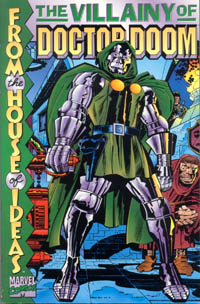
Reprinted in Fantastic Four Annual #7, The Villainy of Doctor Doom TPB, Marvel Masterworks: Fantastic Four Volume 4 (pictured below)
Comments:
At last we are given an expanded origin from the one we got in Fantastic Four #5. Its certainly a surprising one. You can see here that Lee and Kirby were finally settling on what to do with Doom. The tone of the story is very different from what you would expect from the origin of a villain. Not only do I find that it has this horror undertone (dark stormy night, walking around in a castle, visiting an abandoned grave, etc.), but it has a tragic quality. I don't think it was very typical of the day to feel sorry for the villain. I mean how could you not feel sorry for a kid who loses both his parents. It interesting to read this rather straight forward origin and to think about how much stuff has been added since it was originally published. A lot has been added, some things have even changed, but this is still a classic. Bottom Line: * * * * * out of 5